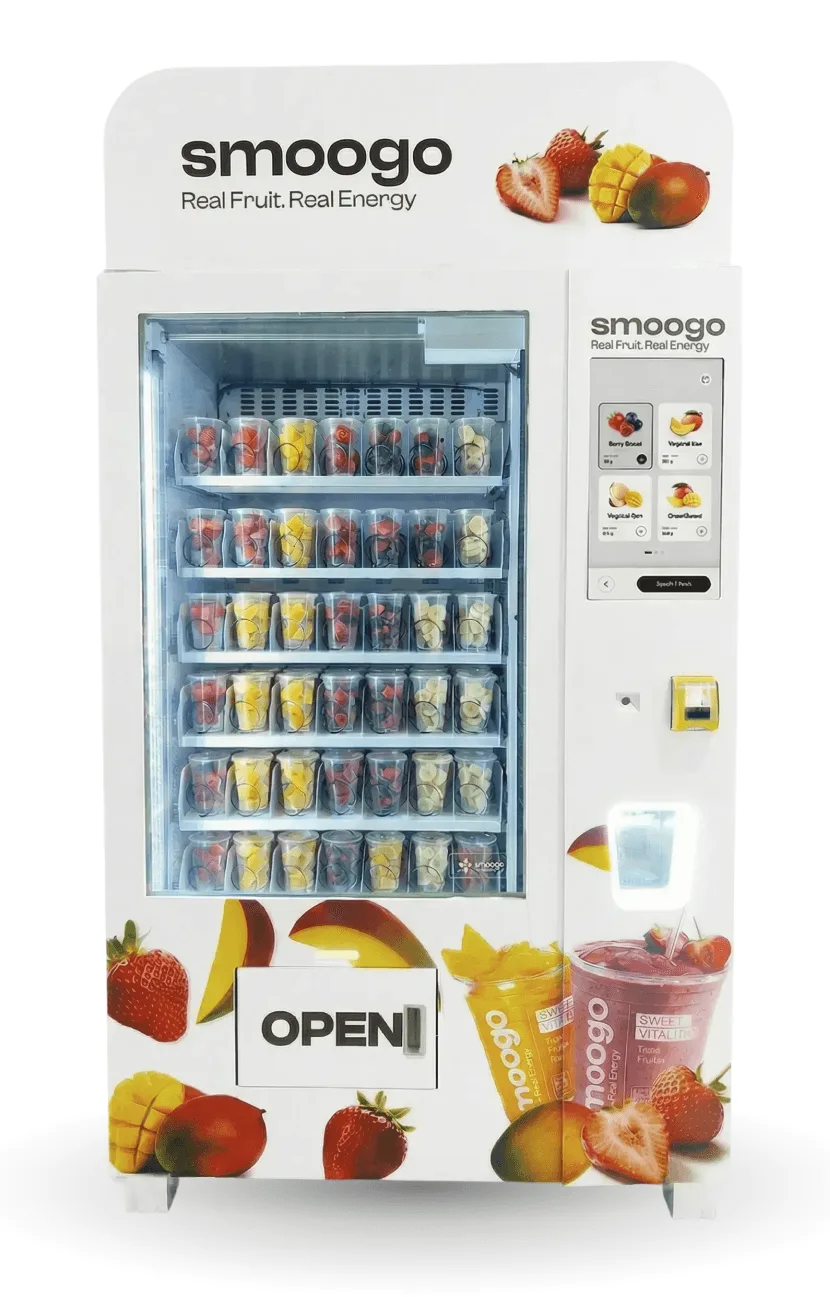
From the outside it looks like a domestic magic trick: you pick a flavour, pay, and in under a minute you are holding a dense, cold, freshly made smoothie. Inside, every cup is the result of an engineering chain designed around a single obsession: that the fruit reaches you exactly as if someone had just blended it in a spotless kitchen. Here is the full journey, station by station.
Station 1: the -18 °C chamber
It all starts in the internal chamber, where the fruit waits portioned by recipe — each portion holding the exact combination for one flavour: the spinach, pineapple, cucumber and kale ratio of a Green Power, or the banana and strawberry of a Pure Vitality. That portioning at source is key: it guarantees every cup carries the exact recipe, without depending on dosing in the moment.
The chamber holds a constant -18 °C, the standard temperature of the frozen chain, with sensors logging any variation. Why does stability matter so much? Because temperature swings are the real enemy of frozen food: cycles of partial thawing and refreezing degrade texture and flavour. At a stable temperature, fruit keeps its properties for up to 2 years — as we explain in detail in frozen fruit vs. fresh fruit. The vending format stores up to 210 smoothies ready to prepare.
Station 2: the order (buy, scan, insert)
Here the user is the protagonist, and the flow is designed to be resolved in three gestures. First, they choose and buy their cup of frozen fruit — the fridge displays the available flavours, each cup with its recipe portioned at source. Second, they scan the barcode on the lid: that code identifies the recipe and tells the machine exactly how much water to dose and which blending programme to run. Third, they take off the lid and insert the cup into the machine. From there, everything is automatic.
The fruit has not broken the cold chain until the very moment of blending: it goes straight from the fridge into the preparation unit.
Station 3: high-power blending
This is where the transformation happens. Blending frozen fruit at -18 °C is nothing like blending fridge-cold fruit: it demands a motor with enough torque to break the frozen fruit without warming it. SMOOGO's blending unit pairs that motor with the exact water dosing of each recipe — no more, which would water it down, no less, which would make it undrinkable.
The detail that defines the product: no ice is added. In a conventional juice bar, ice both chills and dilutes the drink in equal measure. Here the cold is already inside the fruit, so all the flavour intensity stays in the cup. The result is that dense, creamy, icy texture that characterises a well-made smoothie — and the whole process happens in front of the user, who watches their drink take shape in real time.
Station 4: the 30-second self-clean
Once the cup is served, the machine does not wait for the next customer: it immediately runs a 30-second automatic cleaning cycle that washes the entire blending circuit. This cycle solves the two classic problems of any food-processing equipment:
- Hygiene: no residue builds up between servings; every smoothie starts with a clean circuit.
- Flavour purity: one customer's Green Power leaves no trace in the next customer's Açai Boost. Whoever orders a flavour gets that flavour, with no ghost notes from the previous one.
Automatic cleaning is also what makes the staff-free model viable: the machine does not need someone to wash it after every use, only scheduled maintenance visits.
Station 5: telemetry (the invisible employee)
While all of the above happens, the machine constantly reports three data streams to SMOOGO's operations platform:
- Sales by flavour, hour and day: the basis for understanding each location's patterns — a gym's post-workout peak looks nothing like an office's midday peak.
- Remaining stock by flavour: restocking is planned to arrive just before something runs out, not after.
- Technical status and temperature: any deviation from -18 °C or operating anomaly triggers an immediate alert to the team, who act before the user notices anything.
For the host space, this data layer is the difference between "having a machine" and having a managed service: nobody on their team monitors stock, temperature or breakdowns. The machine already does.
The full chain, from farm to cup
Zooming out, the smoothie's full journey begins long before the machine: the fruit is picked at peak ripeness, frozen within hours and transported at -18 °C all the way to the machine's chamber. From harvest to your cup, the fruit has known only two states: ripe and frozen. No artificial ripening chambers, no preservatives, no pasteurisation cooking the flavour. The final step — blending it — is the one you trigger at the press of a button.
Why this design and not another: three engineering decisions
Behind the machine's architecture sit deliberate decisions that explain the result. First: individual portions instead of bulk hoppers. Many drinks machines work from shared reservoirs; SMOOGO portions each recipe separately. It costs more space, but it guarantees exact recipes, prevents cross-contamination between flavours and simplifies traceability for each batch of fruit. Second: blending on demand instead of pre-mixed product. It would be simpler to thaw and serve; blending on demand is mechanically harder, but it is what makes the smoothie genuinely freshly made — and lets the user see it. Third: cleaning after every serving instead of scheduled cleans. Thirty seconds of cycle after every cup looks like a luxury of time, but it eliminates the biggest risk in any food equipment: residue accumulating between manual cleans.
All three decisions point the same way: move the complexity into the machine so the simplicity stays with the user and the host space.
And when something fails? The invisible protocol
No machine is infallible; the difference lies in how a fault is detected and answered. SMOOGO's protocol has three layers:
- Self-diagnosis: the machine monitors its own systems — temperature, motor, dosing, payments — and classifies any anomaly. Many are resolved by an automatic restart of the affected subsystem.
- Proactive alerting: if the problem persists, the alert reaches the technical team with the diagnosis already made, before a user finds the machine out of service. The engineer arrives with the right part, not to work out what happened.
- Product protection: faced with any risk to the cold chain, the system prioritises the product: the fruit is protected by the chamber's thermal inertia and the early alert — -18 °C is not lost in minutes, and the team acts within that margin.
Designed for a user in a hurry
All the engineering above would be useless if ordering a smoothie were complicated. The interface makes three deliberate decisions:
- A three-gesture flow: buy the cup, scan the lid, insert it. No sign-ups, no compulsory apps, no nested menus.
- Nutrition information one tap away: ingredients and values for each flavour on screen — the same transparency as on the website.
- Product theatre: preparation happens in plain sight, deliberately. Watching the fruit being blended is not an aesthetic whim: it is live proof that there is real fruit in there, and the best sales pitch for the next person in the queue.
Want to see it working?
A machine like this is best understood in person: watching the fruit being blended and tasting the result. Take a look at the available formats — compact for small spaces, vending for high traffic — or get in touch and we will arrange a demonstration in your space.
Want a SMOOGO machine in your space?
We install smoothie machines with 100% natural fruit in offices, gyms, universities and supermarkets. We take care of everything: restocking, maintenance and quality control.
Request a proposalFrequently asked questions
Do flavours mix between servings?
No: the 30-second self-cleaning cycle between servings washes the whole circuit, preventing any mixing of flavours and guaranteeing hygiene.
What happens if the cold chain is broken?
The machine monitors temperature continuously and alerts the SMOOGO team to any deviation, before the product is affected.
How often is the fruit restocked?
It depends on each location's consumption: sales telemetry allows restocking to be planned exactly when needed, with no stock-outs and no unnecessary visits.
Why is no ice added to the smoothie?
Because the frozen fruit itself provides the cold and the texture. Adding ice would dilute the flavour; blending fruit at -18 °C concentrates it.