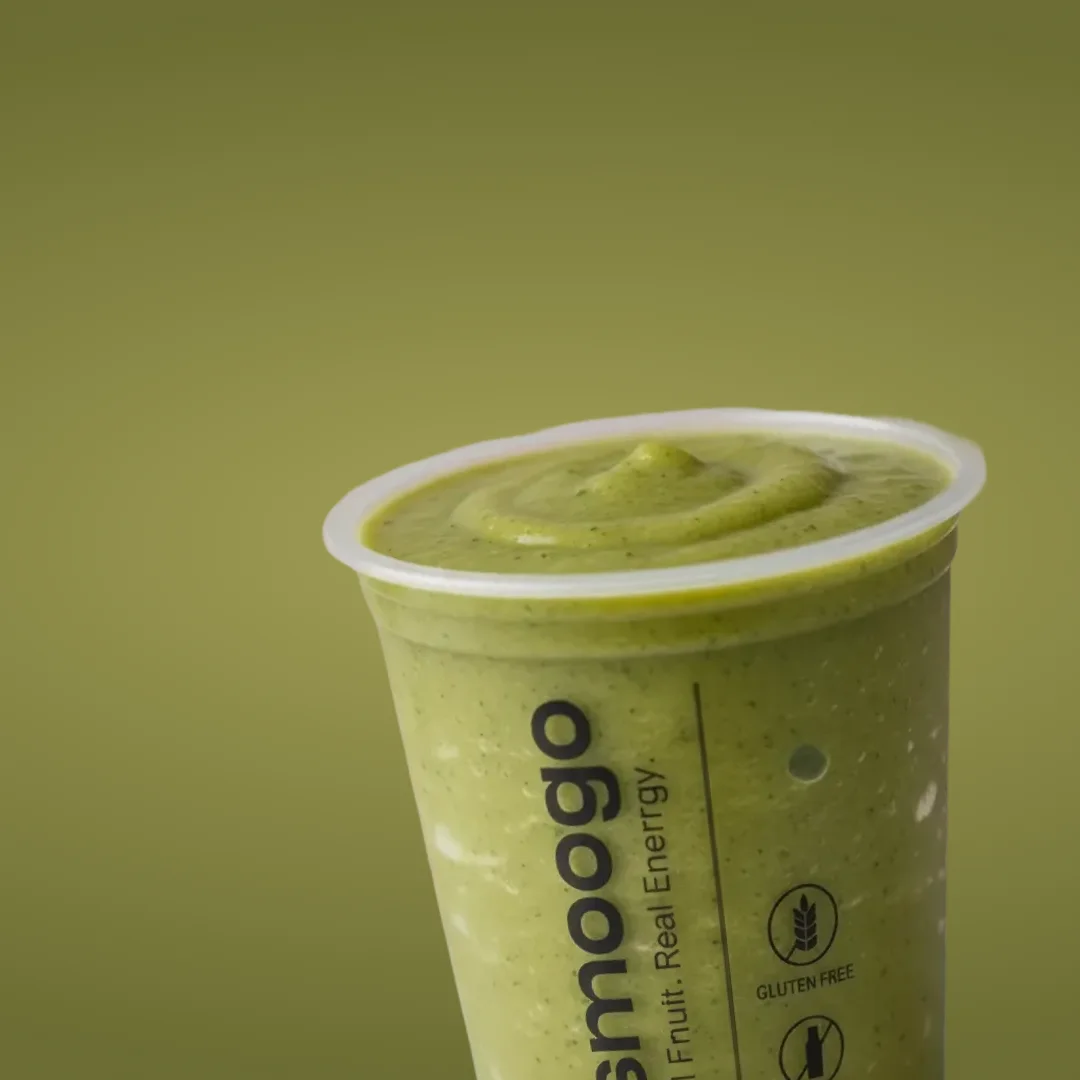
Any office, gym or campus brings together people with coeliac disease, lactose intolerance, vegan diets, nut allergies or simply different preferences. For whoever runs the space, offering a snack that works for everyone is a real problem: almost everything a classic machine dispenses excludes somebody. The natural fruit smoothie is one of the few clean answers to that problem — and not by adaptation, but by nature.
Gluten-free and lactose-free: not a version, the recipe
The food industry has spent years producing "free-from" versions: gluten-free, lactose-free, sugar-free. They are usually reformulations — removing a problematic ingredient and replacing it with something else. SMOOGO smoothies need no such operation because the original recipe is already like that: fruit, vegetables and a small percentage of natural sweetener, mixed with water. There is no milk, no yoghurt, no cereals and no traces of them in the recipe: there is nothing to remove because it was never there.
This has an important practical implication for coeliacs and intolerant consumers: they do not depend on a manufacturer having made a substitution correctly, but on a short, verifiable ingredient list. A Pure Vitality is banana (48%), strawberry (48%) and organic agave syrup (4%). It reads in three seconds and leaves no doubt.
The trick of creaminess without dairy
The classic question: if there is no milk or yoghurt, how does it get that creamy texture? The answer lies in the technique and in the choice of fruit:
- Blended frozen fruit produces a dense, icy consistency on its own. Blending fruit at -18 °C, the fruit's own ice crystals create that creamy sorbet texture — with no added ice (which dilutes) and no dairy (which excludes). We explain it fully in frozen fruit vs. fresh fruit.
- Banana and mango are pure natural creaminess: their starch and pectin content works as a thickener. It is no accident that they appear in several recipes on the menu.
The result competes on texture with any dairy shake — with the advantage that practically anyone can drink it.
Verifiable transparency, flavour by flavour
For someone with dietary restrictions, "it's natural" is not enough: they need to see the list. That is why every SMOOGO flavour publishes its exact composition with percentages on the nutrition facts page:
- Green Power: pineapple, spinach, cucumber, kale and organic agave syrup.
- Açai Boost: mango, banana, açaí, blueberry and organic agave syrup.
- Pure Vitality: banana, strawberry and organic agave syrup.
- Sunshine Energy: mango, pineapple, passion fruit, agave syrup and lemon peel.
Alongside the ingredients are the full nutritional values per 100 g and per serving. Anyone with a specific fruit allergy can check everything before choosing — which is exactly how it should be.
What "inclusive vending" means for a space
Let us put mental numbers on an office of 200 people. With the usual prevalence of coeliac disease, gluten sensitivity and lactose intolerance in the adult population, it is reasonable to expect that several dozen of those people have some restriction involving dairy or gluten. Each of them walks past the classic snack machine — or consumes something that does not agree with them.
Inclusive vending changes that picture:
- In the office, the wellbeing benefit genuinely reaches the whole workforce, not 85% of it — consistent with the idea of healthy vending as a team policy.
- In the gym, where specific diets abound, the post-workout service leaves nobody out.
- In universities and hospitals, with huge and diverse communities, the suitable-for-everyone option is almost a public service obligation.
Coeliac disease and lactose intolerance: what they mean day to day
It is worth distinguishing the two cases, because they demand different things from a food offering:
- Coeliac disease: not a preference or a fad — an autoimmune condition where even traces of gluten cause damage. For someone with coeliac disease, "it contains no flour" is not enough: they need products whose recipe and handling involve no gluten at all. A recipe of fruit, vegetables, organic agave syrup and water, prepared in a circuit that handles only that, is one of the cleanest possible scenarios.
- Lactose intolerance: far more prevalent — affecting a substantial share of the world's adult population to varying degrees. In practice it means the classic dairy-based shake, the most common machine treat, is either off the table or comes at a cost. The water-based fruit alternative removes the problem at the root.
In both cases the pattern repeats: the solution is not an adapted version with small print, but a recipe that never contained the problem.
And also: vegan, and preservative-free
The same short recipe solves other restrictions without setting out to: no ingredients of animal origin (suitable for vegans), no preservatives (cold is the only preservative) and no artificial colourings or flavourings. The list of people who cannot have a SMOOGO smoothie comes down to specific allergies to one of the fruits — and that is what the published ingredient list is for.
What to demand from any inclusive vending provider
If you manage a space and are weighing up options — with SMOOGO or anyone else — this is a reasonable list of demands:
- A complete, public ingredient list, with percentages, per product. If it is hard to find, that is a bad sign.
- Nutritional values per 100 g and per serving, comparable between products.
- Clarity about allergens: what it contains and what it does not, without euphemisms.
- Verifiable process hygiene: in machines that prepare on the spot, how the circuit is cleaned between servings — SMOOGO's 30-second self-clean exists exactly for this.
- A real channel for questions, such as hello@getsmoogo.com.
Food inclusivity is not a slogan: it is verifiable information plus clean processes. Everything else is marketing.
What a space says through its vending
There is an aspect of food inclusivity that goes beyond the practical: what it signals. When someone with coeliac disease arrives at a new office and finds the kitchen machine has an option designed for them too, the message received is not "there is a suitable snack": it is "someone here thought about everyone". Those kinds of signals — small, everyday, undeclared — build the perception of a space far more than any values manifesto.
The same applies in reverse: the gym that prides itself on community while its bar offers only dairy shakes is unintentionally excluding some of its members; the campus that talks about diversity while its vending ignores the most common dietary restrictions sends a contradictory message. Consistency between what a space says and what its vending corner offers is free to achieve — just choose the product well — and very expensive to fake. A smoothie of fruit, vegetables, organic agave syrup and water, with its ingredient list published, is one of the simplest ways to make the message and the reality match.
A space that adds, rather than filters
When a space's vending offers only conventional options, it acts as a silent filter: part of the community is left out. A real fruit machine turns it into the opposite — a service that includes everyone. For an office that looks after its people, a gym that looks after its members or a campus that serves its community, that difference is worth as much as any metric. Let's talk about your space.
Want a SMOOGO machine in your space?
We install smoothie machines with 100% natural fruit in offices, gyms, universities and supermarkets. We take care of everything: restocking, maintenance and quality control.
Request a proposalFrequently asked questions
Do SMOOGO smoothies contain gluten or lactose?
No. They are made only with fruit, vegetables and a small percentage of natural sweetener, mixed with water: naturally gluten-free and lactose-free.
What is the fruit mixed with if there is no milk?
Water. The creaminess comes from the blended frozen fruit itself — especially banana and mango, present in several recipes.
What should someone with a specific allergy check?
The detailed ingredients of each flavour, published with percentages on SMOOGO's nutrition facts page. For specific fruit allergies, that list is the reference.
Are they suitable for vegans?
Yes: they contain no ingredients of animal origin.