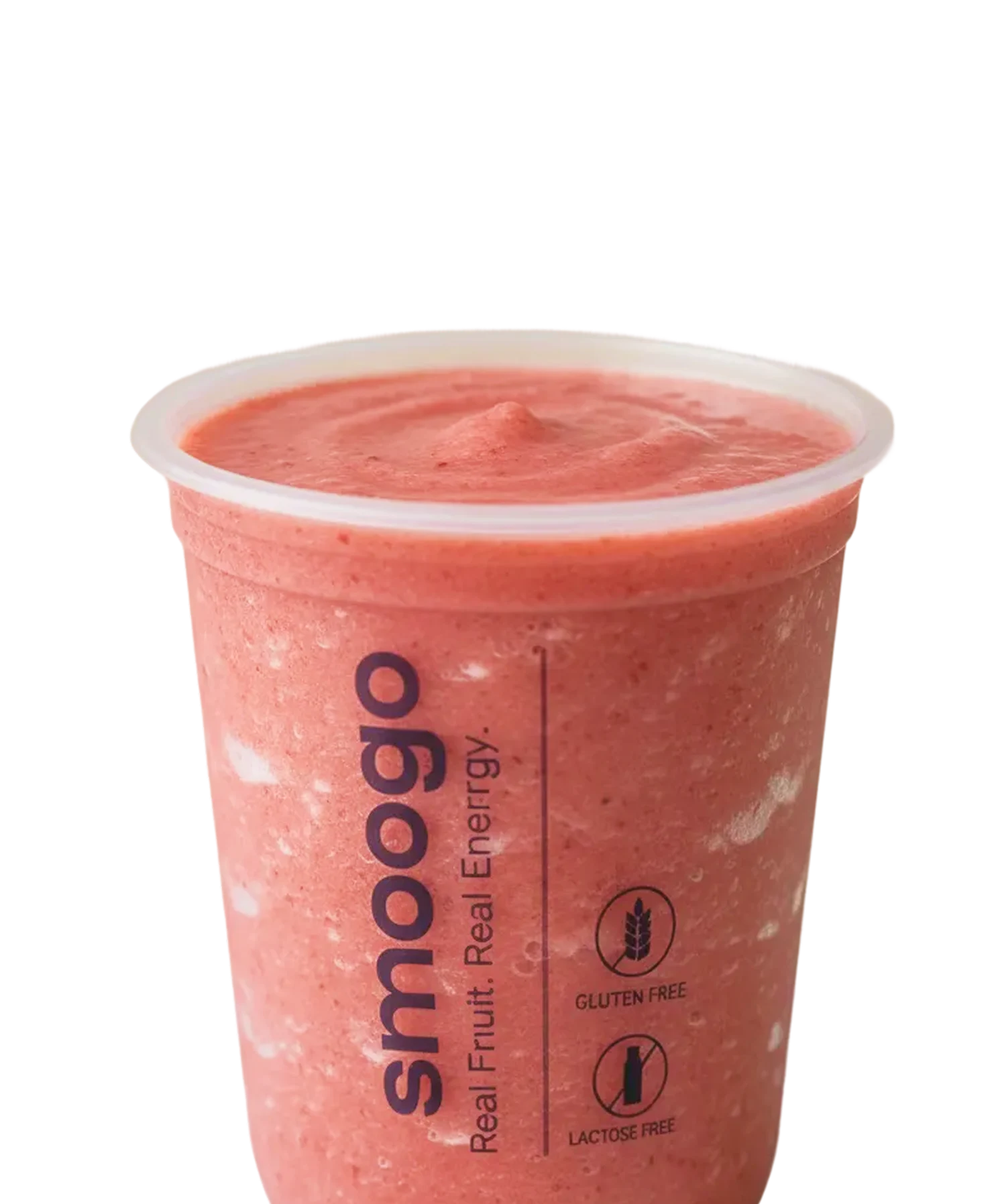
"Natural" is probably the most overused word in food marketing, so let us be precise: when we talk about a 100% natural fruit smoothie we mean whole frozen fruit with a touch of organic agave syrup, blended on the spot and mixed only with water. No concentrates, no powders, no flavourings. With that definition on the table, here are the seven real benefits — no magic claims, just what fruit already does on its own.
1. Vitamins and minerals that come from fruit, not a lab
The vitamins and minerals in a SMOOGO smoothie are the ones its ingredients bring: vitamin C in pineapple, strawberry and mango; potassium in banana; folate and vitamin K in spinach and kale. The difference from a "fortified" drink is where they come from: here the micronutrients arrive in their natural matrix, alongside the rest of the fruit's compounds.
Freezing at -18 °C also locks those nutrients in at the fruit's peak ripeness. That is not a loss compared with fresh fruit: in many cases it is an advantage, as we explain in our piece on frozen versus fresh fruit.
2. Fibre that fills you up (the big difference from juice)
When you squeeze an orange, the fibre stays in the juicer. When you blend the whole fruit, the fibre travels into the cup. That technical difference has three practical consequences:
- Satiety: fibre takes up volume and slows stomach emptying; a smoothie holds hunger off far better than a juice.
- Gradual absorption: the fruit's sugars are absorbed more slowly in the presence of its fibre, avoiding the sharp glucose spike typical of sugary drinks.
- Digestive health: fibre feeds the gut microbiota, a benefit strained juice simply does not deliver.
3. Steady energy, without the spike-and-crash cycle
The problem with a vending-machine snack is not only what is in it, but how it behaves: fast sugars with no fibre produce a rise in energy followed by a crash that calls for another snack. Whole blended fruit plays a different game: its natural sugars arrive with fibre and water, and the resulting energy curve is gentler and longer. Across a working day or an afternoon of studying, that stability shows.
4. Real hydration
Fruit is mostly water: pineapple is around 86%, strawberry 91%. A smoothie is food and a hydrating drink at once — particularly relevant after exercise or in places like gyms, where replacing fluids is the first need. SMOOGO smoothies are made by blending the fruit with water, with no dairy or sugary bases, which keeps that hydrating function intact.
5. Ingredients you understand at a glance
Compare two labels. A typical commercial shake: juice concentrates, stabilisers, flavourings, colourings, preservatives. A SMOOGO Pure Vitality: banana (48%), strawberry (48%), organic agave syrup (4%). There is no small print because there is nothing to hide. We publish the full composition and nutritional values of every flavour — percentages included — on the nutrition facts page.
6. Suitable for almost everyone
With no milk, yoghurt or cereals, natural fruit smoothies are gluten-free and lactose-free by nature — not as an adaptation, but as a consequence of the recipe. In spaces where many people share the same facilities (an office, a campus, a hospital) this matters: it is one of the few vending options almost anyone can have, including people with coeliac disease, lactose intolerance or a vegan diet. We go deeper into this in our article on gluten-free and lactose-free smoothies.
7. The underlying benefit: changing the default option
The biggest benefit is not in the cup, but in the context. Most snacking decisions are made on proximity and speed: whatever is closest wins. When the closest, fastest option is a real fruit smoothie, the healthy choice no longer requires willpower. That is the logic we develop in real alternatives to processed snacks: it is not about banning the chocolate bar, but about matching the convenience of the good option.
Smoothie vs. juice vs. soft drink: the honest comparison
Placed side by side, the three cups tell very different stories:
- Sugary soft drink: free sugars with no nutritional companions — no fibre, no vitamins, no satiety. Instant energy, guaranteed crash and zero contribution to your diet.
- Juice (even freshly squeezed): the fruit's vitamins are there, but the fibre stayed in the juicer. The sugars — natural, yet free — are absorbed quickly. Better than a soft drink, but it is half a fruit.
- Whole fruit smoothie: the complete fruit, with its fibre, its water and its micronutrients, in drinkable form. Absorption is gradual, satiety is real and the ingredient list is readable.
The practical conclusion: if the yardstick is "closest thing to eating the fruit", the order is clear — and the whole fruit smoothie is at the top.
How to fit it into your routine (without turning it into a religion)
A smoothie is not a universal meal replacement or an elixir: it is a convenient way to get real fruit into the gaps in your day where ultra-processed food used to sit. The three most useful moments:
- Mid-morning: instead of the second coffee and biscuits. The fibre carries you to lunch without snacking in between.
- Post-workout: hydration plus carbohydrates with micronutrients, at the moment they are best used — the window we cover in smoothies in gyms.
- The 4 p.m. break: the highest-risk moment for an industrial snack in any office. Changing that one habit, five days a week, is probably the best effort-to-result nutritional improvement there is.
The key to a sustainable habit is convenience: if getting the smoothie takes more effort than getting the chocolate bar, the habit dies within a fortnight. That is why the machine format — always available, no queues — is not a logistical detail but the condition that makes the benefit possible.
Two honest caveats (because not everything is magic)
A serious article about benefits should include the limits too. First: a smoothie does not replace a balanced diet. It is an excellent tool for displacing processed snacks and adding fruit to your day, but it does not make the rest of your eating healthy. Second: fruit contains natural sugars — less problematic than free sugars because they come with fibre, but sugars nonetheless. Anyone following medical advice on sugar intake should choose their flavour carefully: a 42 kcal per 100 g Green Power is not the same as a Tropic Hydrate, which is more energy-dense because of the coconut.
The advantage of a transparent product is precisely that it allows that judgement: with nutritional values published per flavour, each person can decide with data rather than slogans. That honesty — saying what is there, without inflating promises — is part of the brand's DNA, and also why nutritionists tend to look kindly on whole blended fruit compared with most vending alternatives.
Choosing a flavour for your goal
- Light and green: Green Power (pineapple, spinach, cucumber, kale) — just 42 kcal per 100 g.
- Recovery and antioxidants: Açai Boost (mango, banana, açaí, blueberry).
- The classic that never fails: Pure Vitality (strawberry and banana).
- Tropical refreshment: Sunshine Energy (mango, pineapple, passion fruit).
They all share the same base: real fruit, blended on the spot, with energy you can feel and understand. That, in the end, is the honest definition of a natural smoothie.
Want a SMOOGO machine in your space?
We install smoothie machines with 100% natural fruit in offices, gyms, universities and supermarkets. We take care of everything: restocking, maintenance and quality control.
Request a proposalFrequently asked questions
Do natural fruit smoothies contain added sugar?
Yes, a small amount: SMOOGO smoothies use fruit as the base and 4-5 % organic agave syrup to balance the taste. You can see the exact breakdown per flavour on the nutrition facts page.
Is a smoothie the same as a juice?
No. Juice is squeezed and the pulp — and with it the fibre — is discarded; a smoothie blends the whole fruit, keeping fibre, satiety and a more gradual absorption of sugars.
Does a smoothie replace a piece of fruit?
It provides the same fruit, blended, with its vitamins and fibre, in a format that is easier to fit into everyday life. The general advice to eat varied fruit still applies.
Are they suitable for people who are gluten or lactose intolerant?
Yes. SMOOGO smoothies are made with fruit, vegetables, organic agave syrup and water: naturally gluten-free and lactose-free.