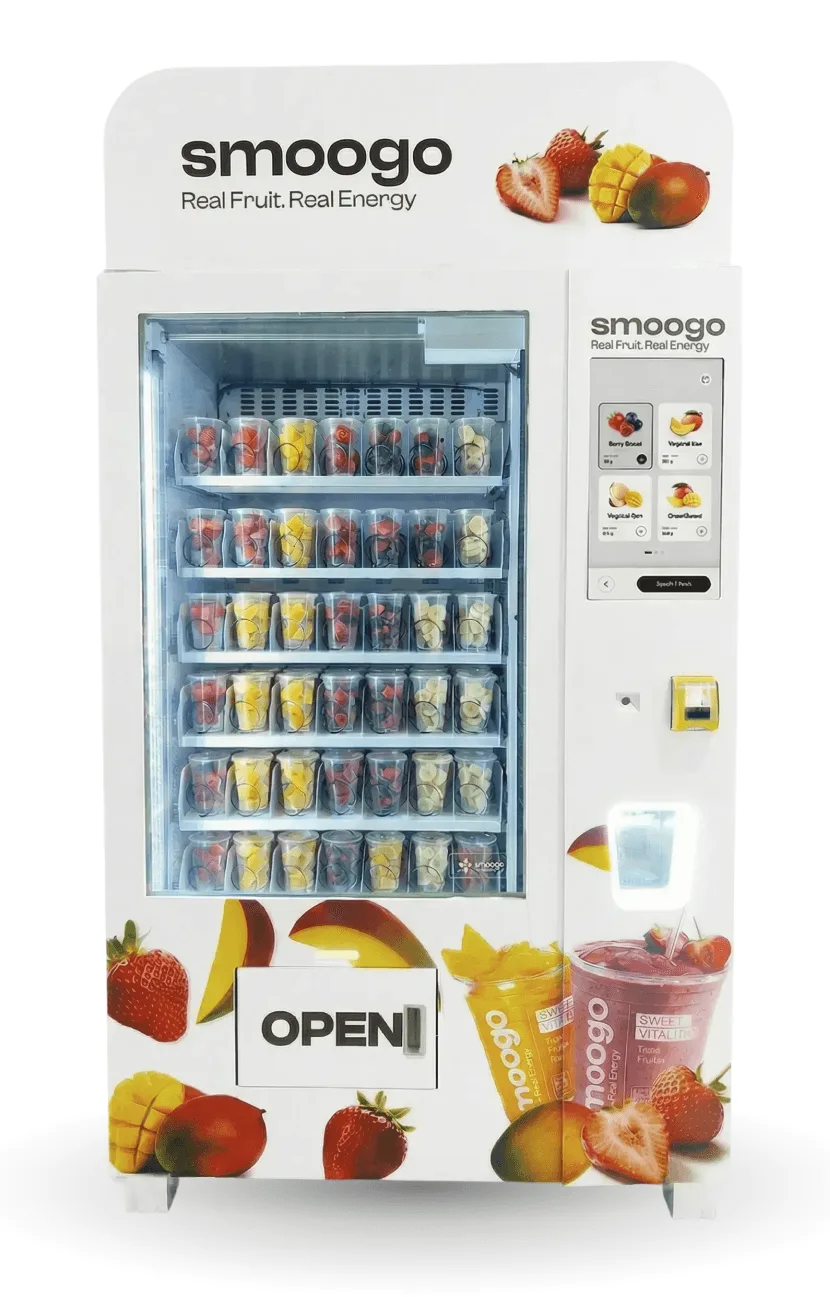
A smoothie vending machine is a machine that, instead of dispensing packaged snacks with months of shelf life, blends a fruit drink on the spot. In SMOOGO's case, the machine keeps 100% natural fruit frozen at -18 °C, blends it the moment you order and mixes it with water to serve a freshly made smoothie in under a minute. It is the answer to a question more and more spaces are asking: why does convenient have to mean ultra-processed?
From the classic vending machine to real fruit
Vending was born to solve an availability problem: food and drink at any hour without depending on someone behind a counter. For decades, the solution was products with very long shelf lives — crisps, chocolate bars, soft drinks — because they were the only ones that could survive weeks inside a machine.
Refrigeration technology changed the rules. If a machine can hold a stable chamber at -18 °C, the product no longer needs to "last": freezing keeps it at its peak indefinitely. That opens the door to something unthinkable a few years ago: real fruit in a vending machine, with no preservatives, no concentrates and no powders to reconstitute.
The difference from bottled juice matters too. An industrial juice, even a "freshly squeezed" one, was bottled days or weeks earlier and has usually lost some of its properties to pasteurisation. A machine smoothie is made in front of you: the fruit was frozen thirty seconds ago and now it is in your cup.
How it works, step by step
The full process, from arriving at the machine to walking away with your smoothie, takes 45 seconds of preparation:
- Pick your cup. Cups of portioned frozen fruit wait in the machine's freezer, each holding the exact recipe for one flavour: Green Power (spinach, pineapple, cucumber, kale), Açai Boost (mango, banana, açaí, blueberry), Pure Vitality (strawberry, banana) or Sunshine Energy (mango, pineapple, passion fruit).
- Buy and scan. Pay for the cup and scan the barcode on the lid: that code tells the machine which recipe it is about to make.
- Take off the lid and insert the cup. The machine blends the frozen fruit right there in the cup, mixing it with water in the exact proportion of the recipe. No ice is added: the icy, creamy texture comes from the fruit itself.
- In 45 seconds, it's ready. You take your freshly made smoothie. Immediately afterwards the machine runs a 30-second automatic cleaning cycle, so flavours never mix.
The technology that makes it possible
Behind that simple experience, three systems work together:
- Continuous cold chain. The internal chamber holds -18 °C with constant monitoring. If the temperature drifts, the system alerts the operations team before the product is affected. At that temperature, fruit keeps its flavour, texture and nutrients for up to 2 years.
- High-power blending unit. Blending frozen fruit takes far more torque than blending fresh fruit. The payoff is worth it: the dense, icy texture that defines a smoothie, without watering it down with ice.
- Telemetry. The machine reports sales, stock by flavour and temperature in real time. With that data the operator schedules restocking exactly when it is needed and spots any incident without waiting for someone to report it.
What sets it apart from traditional vending
Side by side, the generational leap is obvious:
- Product: 100% natural frozen fruit versus long-life ultra-processed snacks. You can see the exact percentage of every ingredient on SMOOGO's nutrition facts page.
- Preparation: made on the spot and in plain sight, versus product manufactured months earlier.
- Additives: none. Cold is the only preservative.
- Diets: naturally gluten-free and lactose-free, suitable for almost anyone.
- Experience: watching the fruit being blended turns a purchase into a small piece of theatre that invites people back.
Smoothie machine vs. juice bar
The natural comparison is not only with classic vending, but with the juice bar down the street. Against one, the machine wins on three fronts and ties on the one that matters:
- Opening hours: a juice bar opens eight or ten hours; the machine, twenty-four. The 6:45 smoothie before work and the 22:30 one after the last shift only exist in the automated model.
- Consistency: behind a counter, the result depends on who is on shift and what fruit arrived that day; in the machine, every portion is dosed by recipe and the fruit was frozen at its peak. Today's cup tastes like last week's.
- Overheads: a juice bar needs premises, staff and daily waste; the machine needs a square metre and a plug. That makes it viable in places a juice bar never could be — an office corridor, a faculty hall.
- Raw material quality: here it is a technical draw, and sometimes a surprise. Many juice bars work with fruit ripened in cold storage; fruit frozen at source reaches the cup with its optimal ripeness intact.
Where does it make sense to install one?
In any space with recurring foot traffic of people who want to look after themselves. The most common cases:
- Offices: as a wellbeing perk for the team and a real alternative to mid-morning coffee and pastries.
- Gyms: the post-workout smoothie is hydration and carbohydrates exactly when the body wants them most.
- Universities: steady energy for long study days on campuses where the quick options are usually coffee and snacks.
- Supermarkets: fresh, differentiating product near the entrance or the checkouts.
- Stations and hospitals: high traffic and a real need for healthy options available 24/7.
SMOOGO offers a compact format for small spaces and a vending format holding 210 smoothies, designed for high-traffic locations.
The usual questions before installing one, answered briefly
"What if it doesn't sell?" — That is exactly why the location analysis matters more than the machine. Recurring traffic and audience fit are studied before installing; telemetry confirms the pattern in the first few weeks.
"Who responds if it breaks down?" — The SMOOGO team, which receives the alert from the machine itself, often before anyone in the space notices. The host does not manage incidents.
"Does it need a water connection?" — Installation is deliberately simple: the basic requirement is a plug socket and the machine's footprint. Each location is assessed during the technical visit.
"What about the cups?" — The fruit cup is the final cup: you take off the lid, the machine blends inside it, and you pick it up ready to drink. No extra consumables to manage.
Who looks after the machine?
This is the part that surprises host spaces most: nobody on your team has to do anything. SMOOGO's model includes the full operation: fruit restocking based on sales data, preventive maintenance, quality control and incident response. The space provides the location and a plug socket. No building work, no staff training, no stock to manage.
A day in the life of the machine, in numbers
To make it concrete, picture a machine installed in a city gym. At 7:00 it serves the first cups to the early risers; between 9:00 and 12:00 the pace slows and the machine uses the lull to report stock and temperature to the operations platform. From 17:00 to 21:00 comes the peak: dozens of servings back to back, each with its full cycle — frozen portion, blending, cup served, 30-second self-clean — without anyone at the centre touching a button. At midnight it is still available for the last shift, and by then the SMOOGO team already knows from the day's data whether the next restock should be brought forward.
That day sums up the whole value proposition: total availability, consistent quality and zero management for the host space. The machine works; the data decides; the fruit reaches the cup at its peak. And the user only sees the good part: a real fruit smoothie, freshly blended, in under a minute.
A change of category, not a passing trend
The smoothie vending machine is not an improved version of the old dispenser: it is a different category. Where there used to be a static, processed product, there is now a small automatic kitchen that works with real fruit and cleans itself. The underlying trend — consumers who read labels and spaces competing to offer wellbeing — is not going into reverse. The question is no longer whether healthy vending will arrive, but which spaces will offer it first.
Want a SMOOGO machine in your space?
We install smoothie machines with 100% natural fruit in offices, gyms, universities and supermarkets. We take care of everything: restocking, maintenance and quality control.
Request a proposalFrequently asked questions
What is a smoothie vending machine?
It is a self-service machine that stores frozen fruit and blends 100% natural smoothies on the spot, with no staff needed.
How long does it take to make a smoothie?
Forty-five seconds of preparation: you buy the cup, scan the barcode on the lid, insert it, and the machine blends the fruit instantly.
Does it need staff to operate?
No. It runs on its own 24/7 and the operator handles restocking and periodic maintenance.
What maintenance does it need?
The machine self-cleans after each serving in 30 seconds. Fruit restocking and preventive maintenance are handled by the SMOOGO team based on each location's sales data.
How much space does it take up?
It depends on the format: the compact version fits into an office corner with a plug socket; the vending format, designed for high traffic, takes up about as much as a large conventional machine.